




PUBLISHED
November 26, 2026
Learning to Try Again: How Nature-Based Experiences Support Persistence and Resilience in Early Childhood
Authors:
Eileen Chia, Mavis Tan
Source:
PECERA Conference July 2026
Keywords:
Mastery Motivation, Nature-based Programmes, Resilience
Abstract:
A collaborative study by the NTUC First Campus Centre for Early Childhood Transformative Practices (CECTP) and NTUC First Campus Outdoor School (OSS) examined how nature-based programmes support resilience in 714 Singapore preschoolers aged 5-6, focusing on mastery motivation, persistence and problem-solving. Using a mixed-methods design comprising educator-completed questionnaires (DMQ-18), field observations and parent surveys, our study examined changes before and after OSS programmes, with a subset followed across two years. Findings revealed significant improvements in cognitive task persistence, physical problem-solving and overall competence across K1 and K2 cohorts. Notably, children demonstrated growth regardless of their initial persistence profiles, suggesting that nature-based experiences support children with varying starting levels of persistence. However, findings on affective responses were more nuanced, pointing to the potential importance of adult facilitation in helping children navigate challenges. Together, these findings underscore the developmental potential of authentic outdoor experiences in nurturing persistence, problem-solving and the willingness to try again.
Summary
Our two-year study involving 714 preschoolers explored how nature-based outdoor experiences support resilience through persistence and problem-solving. Findings revealed improvements in children’s persistence and competence across different starting profiles, highlighting the developmental value of authentic outdoor challenges and opportunities to try again.
Understanding Mastery Motivation in Young Children
Mastery motivation refers to children’s intrinsic drive to tackle challenging tasks, persist through difficulties and their experience of joy in mastering new skills (Morgan et al., 1990). When preschoolers encounter a steep, muddy slope or a wobbly log, what keeps them trying? It is in these small everyday moments of overcoming obstacles outdoors that provide meaningful opportunities for children to develop persistence and confidence in navigating challenges, laying important foundations for resilience.
About the Study
To better understand how outdoor nature-based learning experiences support the development of resilience in preschoolers, the NTUC First Campus Centre for Early Childhood Transformative Practices (CECTP) and NTUC First Campus Outdoor School Singapore collaborated on a two-year research project aligned with Singapore’s broader vision of making outdoor learning accessible to “every child, everywhere, every day” (ECDA, 2019). Our study involved 714 children (301 Kindergarten 1 and 413 Kindergarten 2) and 82 educators across 14 NTUC First Campus centres, with a subset of 225 children followed across 2025 and 2026 to examine patterns of developmental change over time.
Using a mixed-methods approach, educators rated children’s mastery motivation using the Dimensions of Mastery Questionnaire (DMQ-18; Morgan et al., 2020) before and after participation in two- or three-day OSS outdoor programmes conducted at local nature parks and wetland reserves. The ratings were complemented by on-site field observations of children’s persistence and problem-solving during authentic outdoor challenges, alongside parent surveys capturing children’s outdoor experiences and persistence-related behaviours at home. Together, these sources offered a more comprehensive understanding of how children navigate challenges and develop persistence through nature-based experiences.
Research Findings
The educator-completed responses using the DMQ-18 revealed significant improvements in Cognitive/Object Persistence, Gross Motor Persistence and General Competence across both K1 and K2 cohorts in 2026. Children demonstrated greater persistence in thinking and physical challenges, while both cohorts also showed significant gains in their overall competence in managing moderately challenging tasks. Mastery Pleasure showed a modest increase in K1, and with significant improvements observed in K2. Conversely, Negative Reactions to Challenges saw a decrease in K1, while remaining relatively stable in K2. These contrasting patterns suggest that children’s persistence and affective responses to challenges may develop differently across developmental stages.
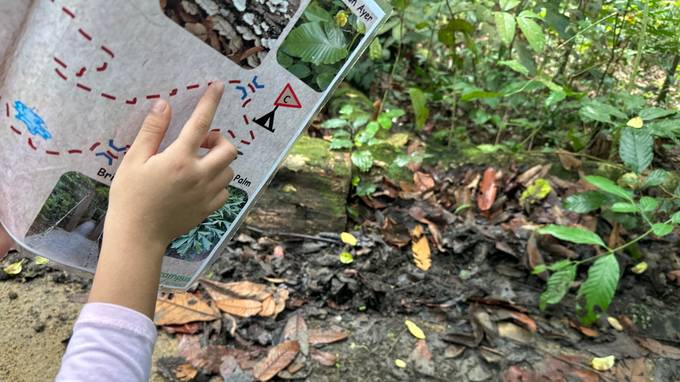
Field observations brought these findings to life, revealing how children navigated authentic challenges along nature trails. Expressions of discomfort, frustration or hesitation did not necessarily signal disengagement. Children often voiced their frustrations while continuing to try, sometimes with gentle instructor support. Whether adjusting their footing on wobbly logs or attempting an obstacle again after a setback, children demonstrated persistence through physical problem-solving. Some expressed pride in attempting something new and unfamiliar, while others celebrated quieter moments of mastery through a smile or a tight grip on the gem they had just earned. These observations highlight how persistence can coexist with emotional discomfort. They also underscore the role of intentional adult facilitation in helping children navigate difficulties, recognise their efforts and find the courage to try again.
In addition, parent surveys revealed that children who were described by their parents as giving up easily at home began with lower persistence scores, yet demonstrated gains comparable to their peers. This encouraging finding suggests that nature-based experiences may support the development of persistence across children with varying initial dispositions and persistence habits.
Among the 225 children the studied followed across K1 (2025) and K2 (2026), the findings revealed significant improvements in persistence and competence following OSS programmes in both years, with descriptively greater gains observed in K2. Taken together, these findings suggest that repeated nature-based experiences may provide continued opportunities to strengthen mastery motivation and sustain developmental momentum as children grow.
Why It Matters
Nature-based environments present unpredictable situations that invite children to navigate challenges, explore solutions and make decisions in ways that may be less readily available in structured classroom settings. Our findings suggest that persistence and emotional responses to challenges may develop differently. While hands-on problem-solving offers opportunities to strengthen persistence, navigating the emotional demands of these experiences may benefit from more intentional adult facilitation.
Educators play an important role in helping children recognise frustration as a natural part of learning rather than a sign of failure. By acknowledging these emotions and allowing children time and space to recover before they try again, adults support both children’s persistence and their growing capacity to navigate setbacks.
Building resilience is not simply about encouraging children to persevere, but also about supporting them through the challenges and emotions that accompany learning. Moving forward, NTUC First Campus Outdoor School remains committed to refining nature-based programmes that create meaningful opportunities for children to exercise agency, develop persistence and grow in resilience.
To find out more, you may email us.
References:
Early Childhood Development Agency. (2019). Outdoor learning: A national guide for early childhood educators. https://www.ecda.gov.sg/docs/default-source/default-document-library/early-childhood-educator/outdoor-learning-a-national-guide-for-early-childhood-educators.pdf
Morgan, G. A., Harmon, R. J., & Maslin-Cole, C. A. (1990). Mastery motivation: Definition and measurement. Early Education and Development, 1(5), 318-339. https://doi.org/10.1207/s15566935eed0105_1
Morgan, G. A., Liao, H.-F., & Józsa, K. (Eds.). (2020). Assessing mastery motivation in children using the Dimensions of Mastery Questionnaire (DMQ). Szent István University. https://real.mtak.hu/134921/
Share this article

From Reflection to Agency: Applying the PERMAH Framework to Deepen Educators’ Pedagogical Responsiveness
Although child agency is widely recognised as central to quality early childhood education, translating child-centred principles into consistent pedagogical practice remains challenging. This qualitative study examined how structured reflection guided by the PERMAH framework supports educators’ professional transformation and pedagogical responsiveness to children’s agency. Twelve lead educators from NTUC First Campus, Singapore, participated in the...

Beyond High Fidelity: Refining Preparation, Differentiation, and Checklist Usability for the the New Numeracy Curriculum (2026)
This study examined teachers’ implementation of a new numeracy curriculum across N2, K1 and K2 classrooms, focusing on implementation fidelity, perceived difficulty, and the usefulness and ease of an accompanying tracking checklist. Teachers completed a structured implementation survey using four-point rating scales. Overall implementation fidelity was high, while lesson implementation difficulty was moderate. The main...
TheraNest: Improving the efficiency and consistency of child therapy documentation process using AI
TheraNest is a digital platform designed to support therapists in documenting, organising, and communicating children’s therapeutic progress in a structured and efficient manner. Therapeutic work with children involves numerous small but meaningful observations that contribute to understanding developmental progress over time. However, recording these insights consistently while managing clinical workloads can be challenging. TheraNest provides...
Baseline Sustainability Awareness Among Children in 2025
This paper presents the 2025 baseline profile of sustainability awareness among K1 and K2 children, based on a validated assessment tool measuring reasoning across six environmental domains. Findings show that children demonstrate foundational sustainability understanding from K1, with K2 children consistently offering deeper eco-centric reasoning. Domain-level analyses highlight developmental shifts in the sophistication of children’s...

The Effects of Outdoor School Programmes on the Resiliency of Five Year Olds
This study looked at the effects of Outdoor School (OSS) programmes on the resiliency of five-year-olds by examining children’s mastery motivation. Mastery motivation reflects children’s willingness to engage in moderately challenging tasks, persisting in an independent focused manner. A mixed-methods approach with teacher questionnaire ratings for children before and after their programme, in-field observations, and...

A Longitudinal Study: Measuring Children’s Development and Learning Outcomes (1 to 6 Years Old)
The Longitudinal Study is a six-year project tracking children’s well-being, language, physical, and cognitive development across two phases. Phase 1 (2019–2021) evaluated the Relationships-Based Curriculum (RBC), while Phase 2 (2023–2025) followed the same cohort from ages 4 to 6, examining the changes in the measured outcomes, and how parents help their children safely navigate the...
Research & Advocacy
Learn about the latest research we do that drives our curriculum